WorldIsrael · Asia
Gadi Eisenkot: Ex-Army Chief's Bloc Narrowly Ahead of Netanyahu in Israel, but Short of a Majority
Gadi Eisenkot wants to unseat Netanyahu as Israel's prime minister. According to exit polls, his bloc falls short of a majority – and on the Palestinian question he is hardly less hawkish.
By Marcel
Automatically translated from German · may contain errors · Read the original
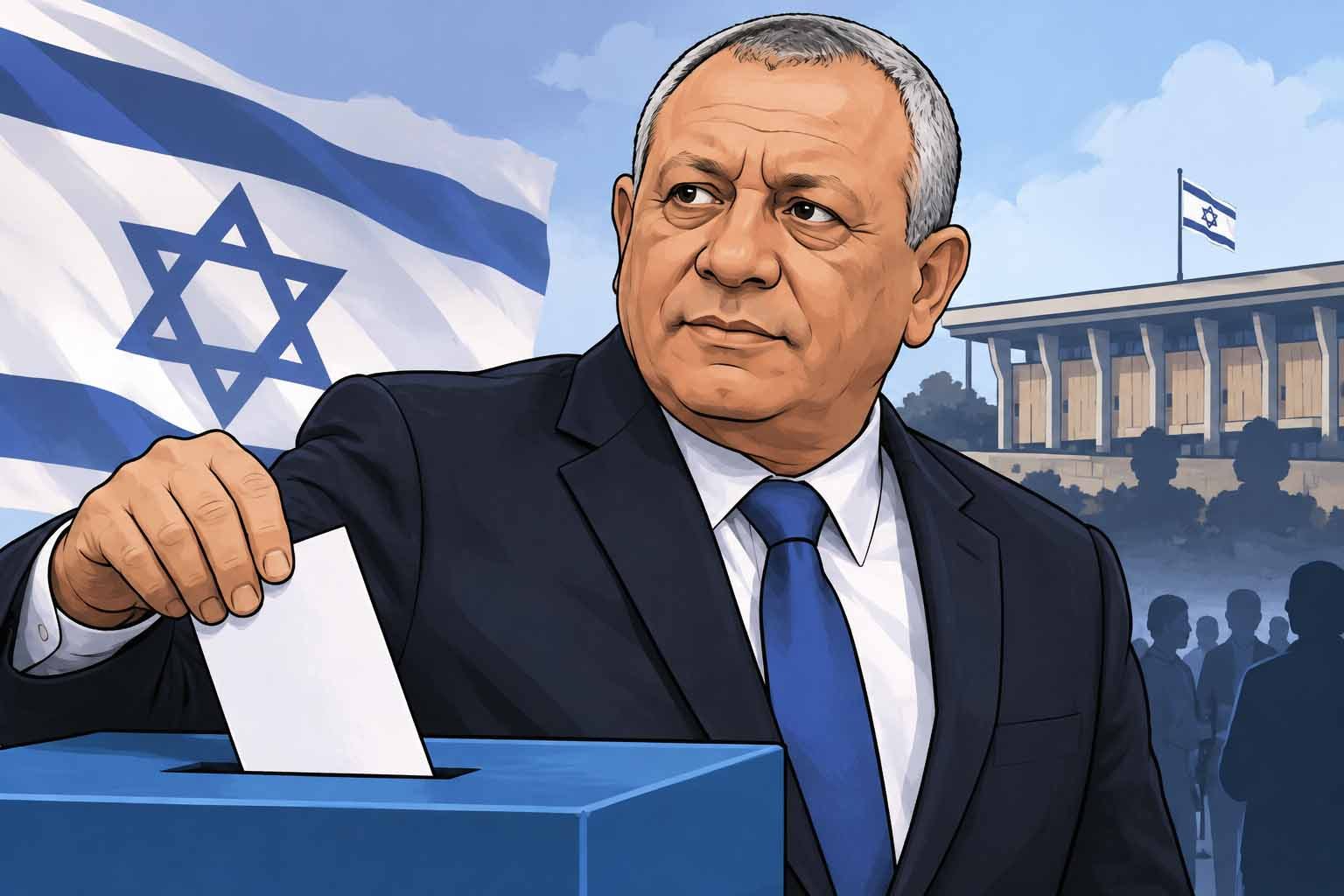
In Israel's parliamentary election on Tuesday, October 27, the opposition bloc led by former chief of staff Gadi Eisenkot is narrowly ahead of Prime Minister Benjamin Netanyahu's bloc, according to initial exit polls. Neither camp reaches the 61-seat majority, the polls indicate. The figures are preliminary; official results from Israel's Central Elections Committee were expected overnight.
Projections from Israel's major television networks put Eisenkot's bloc at 52 to 53 seats, Netanyahu's camp at 50 and the Arab parties at 17 to 18. The largest single party is Netanyahu's Likud with 24 to 25 seats, ahead of Eisenkot's party Yashar with 21 to 23. Channel 14, a broadcaster close to Netanyahu, however, gives the right-wing camp 60 seats.
Shortly after the projections were released, Eisenkot said they showed a complete lack of trust in Netanyahu. He announced that he would swiftly replace the government and promised to keep a tough line on security. CNN reported the highest voter turnout since 1999 and cited a deadlock, a minority or unity government, or new elections as possible outcomes.
From a miner's son to chief of staff
Eisenkot was born on May 19, 1960, in Tiberias in Galilee. His parents were Jewish immigrants from Morocco; his mother came from Casablanca, his father from Marrakesh. The family name was originally Azenkot; an official changed the spelling to Eisenkot.
The 66-year-old grew up in Eilat on the Red Sea, where the family moved when he was about a year old. His father worked in the copper mines of Timna, and his mother was a homemaker. Eisenkot studied history in Tel Aviv and political science in Haifa and attended the U.S. Army War College. He has been married since 1984, has five children and lives in Herzliya.
He was drafted into the army in 1978. He dropped out of pilot training after a month and switched to the Golani Infantry Brigade, which he later commanded. He served as military secretary to Ehud Barak, led the Judea and Samaria Division as well as Northern Command, and was deputy chief of staff. From 2015 to 2019 he headed the Israeli military as its 21st chief of staff, the first with a Mizrahi background. In early 2019 he retired after about 40 years of service.
Hard line as a military man
Eisenkot became known for the so-called Dahiya Doctrine, a strategy of disproportionate retaliation applied against Hezbollah in the 2006 Lebanon War. He is also known for the "campaign between the wars" against Iran and for Operation Northern Shield against Hezbollah tunnels.
As chief of staff, he backed the conviction of a soldier who had shot a Palestinian attacker who was already incapacitated. That earned him respect among liberals and anger from the right.
War cabinet and personal losses
After the Hamas attack of October 7, 2023, Eisenkot sat in the war cabinet as a minister without portfolio and without a vote. In June 2024 he resigned because he no longer supported Netanyahu's course in the war and on the hostages.
In the Gaza war, Eisenkot lost three relatives. His son Gal, a 25-year-old medic and reservist, was killed on December 7, 2023, in Jabalia while searching for hostages. A nephew died a day later, and another was killed in November 2024.
In 2025, Eisenkot left Benny Gantz's party, accusing it of a lack of internal democracy. He founded Yashar, Hebrew for "straight" or "honest." Ahead of the election, polls had the party ahead of Likud or level with it.
No counterweight on the Palestinian question
On the Palestinians, Eisenkot takes positions similar to Netanyahu's. He rejects a Palestinian state and said in August, in essence, that there would be no such state under a government with him. He gives priority to the Jordan Valley and the large settlement blocs. In 2022, before entering the Knesset, he had still dodged the question of a two-state solution.
For the Gaza Strip, Eisenkot seeks a long ceasefire, demilitarization and the destruction of Hamas's military wing. The news agency Reuters cites a time frame of about 18 months for this and describes Eisenkot as a hard-line alternative: he breaks with Netanyahu's leadership and its far-right partners, but not with its security policy.
Different in style and domestic policy
Eisenkot differs more clearly in demeanor and on domestic issues. He does not come from a political elite family, is regarded as sober and rarely appears in public. Israel has never had a Mizrahi prime minister.
Eisenkot holds Netanyahu partly responsible for the failure on October 7 and calls for a state commission of inquiry. He supports universal conscription, including for the ultra-Orthodox. He wants a judicial overhaul only with broad consensus. He rejects far-right partners such as Itamar Ben-Gvir as the price of power.
A difficult search for a majority
Eisenkot does not rule out a government with Likud without Netanyahu, but he rejects a majority with the Arab parties. Without Netanyahu and without Arab lists, 61 seats are mathematically hard to reach. As we reported on October 27 in our coverage of the projections for the election in Israel, Eisenkot would depend on Arab parties for a majority.
There is also distrust among allies. Avigdor Lieberman of the Yisrael Beytenu party, part of the anti-Netanyahu camp, voiced suspicion shortly before the election that Eisenkot might yet strike a deal with Likud. Ben-Gvir and the far right are hostile toward him. Shortly before the election, Likud demanded an investigation into Eisenkot's campaign manager over the publication of data from the betting platform Polymarket and filed a complaint with the elections committee over campaign advertising on Facebook.
On October 21, Eisenkot ruled out cooperating with Netanyahu himself in an interview on Radio 103FM. He said he would not serve under Netanyahu, "not even in a rotation agreement." If it did come to that, he would resign "an hour later."