WorldValle de la Pascua, Venezuela · Americas
Video: Does Cola Put Out Fires? Engineers Warn Against Transformer Stunt in Venezuela
A worker for Venezuela's state power utility Corpoelec threw bottles of cola at a burning pole-mounted transformer. Experts call it dangerous improvisation.
By Marcel
Automatically translated from German · may contain errors · Read the original
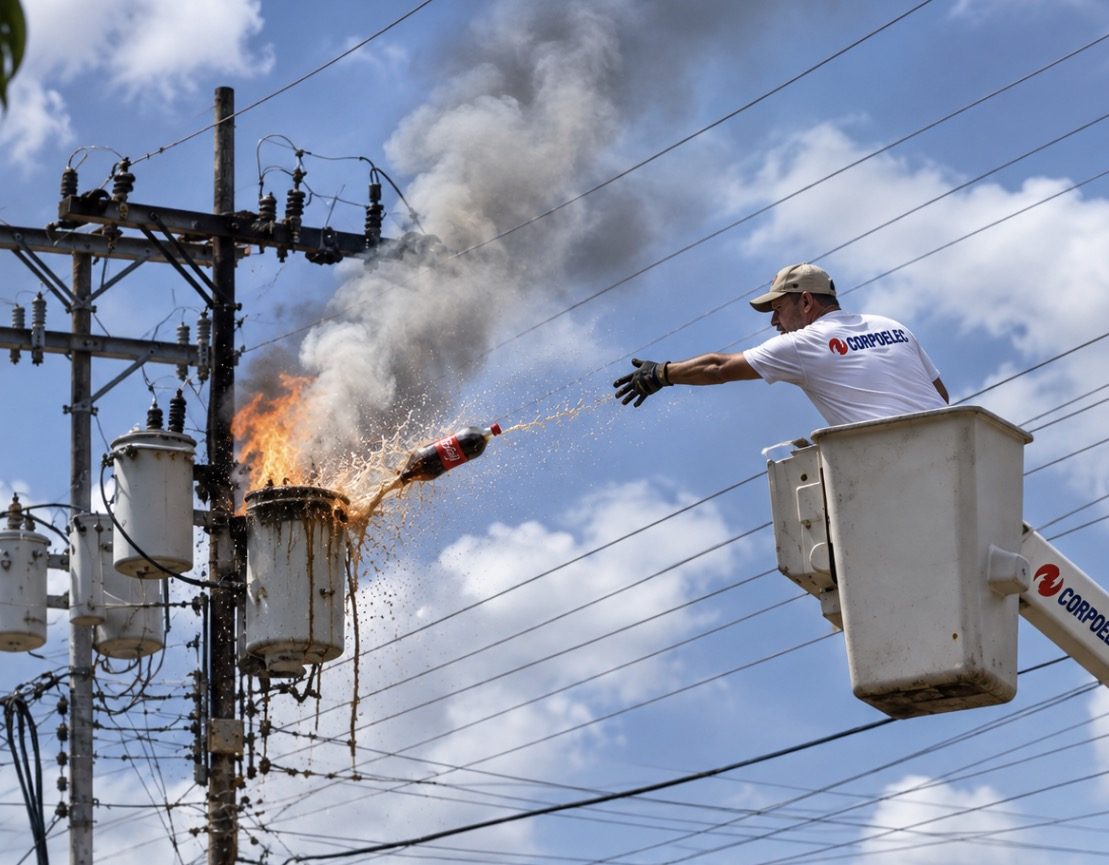
A lineman for Venezuela's state-owned power utility Corpoelec tried to put out a burning pole-mounted transformer with soda in Valle de la Pascua, in Guárico state. According to the news site La Patilla, which reported on the video on Monday, Nov. 2, the man threw three two-liter bottles at the transformer from a bucket truck and ducked away each time.
On Wednesday, Nov. 4, the Turkish account Kaynak Haber posted the clip on X, claiming the cola had put out the fire. Venezuelan engineers disagree and warn against copying it.
Flash fire after every throw
The video shows a residential street with tile roofs and numerous overhead power lines. At the top of a pole, a cylindrical transformer is burning, with flames and smoke rising. The man in the bucket wears a white T-shirt, cap and sunglasses; he apparently wears no helmet or protective gear.
After one throw, a jet of flame shoots toward the bucket and the man takes cover. The flame dies down and smoke remains, then the fire returns while he already has the next bottle in hand. Only after the third throw did the fire apparently go out, La Patilla wrote.
It is unclear whether the man was injured and what caused the fire. Corpoelec has not commented publicly on the incident.
Video seen as sign of the power crisis
In Venezuela, the clip was seen less as a trick than as a symptom of the country's dilapidated power grid. Residents criticized that the crew was apparently working on an exploded transformer without a fire extinguisher and without protective equipment. La Patilla also raised questions about the working conditions of the crews.
The outlet Grupo Marmor placed the incident in the context of Venezuela's power crisis, which has lasted more than ten years and which, it said, worsened in 2026.
Engineers: Water on hot oil is dangerous
Under the post on X, users argued that it was not the cola but the carbon dioxide that smothered the fire. According to engineers, that doesn't hold up: a two-liter bottle contains, by rough estimate, only six to eight grams of CO₂, while a small CO₂ extinguisher holds two kilograms.
Transformer fires usually start from insulating oil under electrical load. Soda is mostly water, which vaporizes instantly on hot oil and can trigger a fireball. A shaken, closed bottle can also burst in the heat. The liquid cools only briefly, and the oil often keeps burning afterward.
Electrical engineer Jesús Olivares told the outlet El Pitazo that such incidents call for suitable extinguishers, such as dry-powder or carbon dioxide units, "never soft drinks." Each time the liquid was thrown, a flash fire erupted that forced the lineman to seek cover behind the bucket, he said. Because soda contains water, it also conducts electricity toward the worker, he added.
Jacobo Vidarte, a risk management specialist from San Diego in Carabobo state, called it dangerous to fight an oil or hydrocarbon fire with water or soda. The correct approach, he said, is to shut off the power line, clear the area and use a CO₂ or dry-powder extinguisher. Otherwise, there is a risk of electric shock, burns and explosions.